
Why does the Landoll Bendi hold more than 85% market share in the very narrow aisle category?
When the goal is maximizing storage density without giving up productivity, few forklifts have earned a reputation like the Landoll Bendi Very Narrow Aisle Forklift. The Bendi was designed around a simple idea: let warehouses narrow their aisles without losing the versatility of a conventional forklift. That combination is why it has become the go-to solution for operations trying to add pallet positions, avoid the cost of a building expansion, and move more product through the same four walls. So what actually separates the Bendi from other very narrow aisle forklifts? Five things: rear-wheel drive, stability, gradeability, visibility, and flexibility. Here is how each one works and what it means for your operation.
1. Rear-wheel drive helps reduce maintenance costs

The biggest engineering difference between the Bendi and most competing articulated forklifts is its patented rear-wheel drive design. Front-wheel drive articulated trucks route motor cables, hydraulic hoses, and other components from the truck body forward to the steering assembly. Every time the mast articulates, those components twist and flex. Over thousands of operating hours, that constant movement produces a predictable result: wear, damage, and a maintenance bill that climbs as the truck ages. The Bendi’s rear-wheel drive design keeps those critical components out of the twisting path, which sharply reduces that cycle of flex and fatigue.
Benefits of the rear-wheel drive design
- Less wear on motor cables and hydraulic hoses
- Lower maintenance requirements
- Improved component longevity
- Reduced downtime
- Lower total cost of ownership
The numbers back it up. Historical operating data shows that Bendi LP gas forklifts average approximately $1.61 per operating hour in maintenance costs over the life of the equipment. With the introduction of the DuraSteer System, that ownership cost is expected to decrease further by improving steering system durability and reliability. If you evaluate equipment on lifecycle cost rather than purchase price, this is where the Bendi quietly separates itself over the life of the truck.
2. Superior stability and capacity retention at lift height
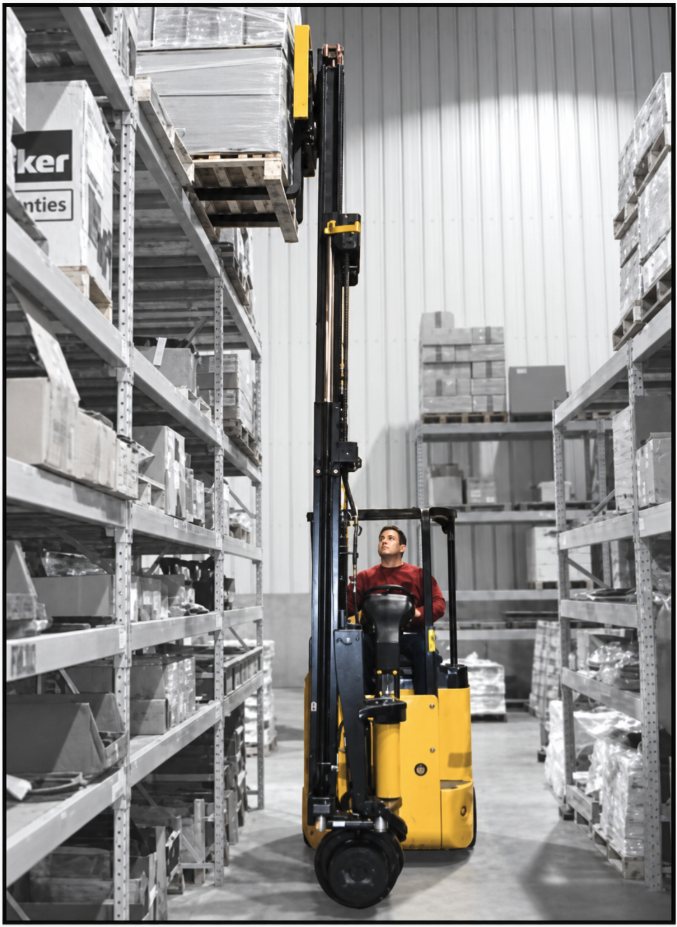
Capacity ratings matter. What matters more is how much of that capacity you still have when the forks are at the top of the rack. Because the Bendi’s drive motors are mounted toward the rear of the truck, weight distribution is optimized for stability. That balance is what lets the truck hold onto its load-handling capability at elevation, where front-wheel drive units tend to fall off.
Real-world capacity comparison
| Lift height | Bendi capacity | Competitor capacity |
|---|---|---|
| 168 inches | 4,000 lbs. | 4,000 lbs. |
| 198 inches | 4,000 lbs. | 3,800 lbs. |
Based on a 24-inch load center. At 168 inches the two are identical. At 198 inches the Bendi holds its full 4,000 lb. rating while comparable units drop to 3,800 lbs.
Why this matters
The ability to maintain rated capacity at height helps operations:
- Store heavier product in upper rack locations
- Avoid moving up to larger, more expensive equipment
- Improve warehouse cube utilization
- Increase productivity without sacrificing safety
Moving drive system weight toward the rear of the truck improves overall balance while minimizing the front axle weight that can compromise stability. It is one of the defining engineering advantages of the Bendi design. The practical takeaway for buyers: if your racking goes high, the rating on the spec sheet at 168 inches is not the number you should be shopping on. Ask for the capacity at your actual top beam level.
3. Industry-leading gradeability and EE rating
Warehouse operations rarely run on perfectly flat surfaces. Loading docks, ramps, trailer approaches, and exterior transitions all require a forklift to maintain traction while carrying a load.
Gradeability comparison
When loaded, the Bendi climbs a 15% grade. Competing units typically max out at 12%. That advantage traces straight back to the patented rear-wheel drive system, which positions motor weight where traction is needed most. Front-wheel drive articulated forklifts face the opposite problem: much of the machine’s weight sits toward the rear while traction is demanded from the front axle. The Bendi design reverses that, giving operators stronger traction and better control on grades.
Benefits of improved gradeability
- Better ramp performance
- Increased operator confidence
- Improved traction under load
- Greater operational flexibility
- Smoother dock-to-warehouse movement
The Bendi EE rating
Another differentiator is the availability of an EE rating. An EE-rated forklift is a spark-resistant electric truck built for environments that require additional protection around:
- Flammable vapors
- Combustible dust
- Chemical storage
- Sensitive manufacturing processes
For facilities with specialized safety requirements, the EE rating opens the door to applications that many VNA trucks simply cannot serve.
4. Enhanced visibility improves safety and efficiency

Visibility is one of the most overlooked contributors to forklift productivity and workplace safety. The Bendi’s rear-wheel drive design and DuraSteer System allow for a lower-profile front-end configuration, giving operators a clearer view of the forks and the load.
Front visibility benefits
- Improved pallet placement
- Faster load engagement
- Reduced product damage
- Better rack positioning
- Greater overall efficiency
The advantage continues in reverse. Many competing units position the radiator behind the operator, which restricts the rearward line of sight and increases the risk of damage. Bendi encloses the radiator within the engine compartment instead, keeping that sightline substantially clearer.
Rear visibility benefits
- Improved travel visibility
- Better awareness in congested areas
- Reduced risk of collisions
- Enhanced workplace safety
When operators can see, they move more efficiently and more safely throughout the building.
5. Exceptional flexibility in trailers and sea containers
The Bendi’s most distinctive advantage is its versatility. The combination of rear-wheel drive and the DuraSteer System lets the Bendi use conventional Class II forks while maintaining an extremely compact profile. The result is a remarkably low collapsed mast height. Collapsed mast height: 87 inches That specification is what allows the Bendi to fit into standard 89-inch sea containers, giving operators the ability to move directly between:
- Narrow warehouse aisles
- Shipping containers
- Sea containers
- Trailers
- Loading docks
Most alternative narrow aisle solutions cannot perform all of those tasks with a single truck. And even if container loading is not part of your operation today, equipment that can adapt to future requirements protects the investment.
Bendi vs. reach trucks: understanding the difference
Many operators evaluating very narrow aisle equipment weigh Bendi forklifts against reach trucks. Both increase storage density, but they serve different applications.
Reach trucks are best suited for:
- Dedicated warehouse environments
- Extremely narrow aisles
- Rack storage applications
Bendi forklifts are best suited for:
- Warehouse storage
- Trailer loading
- Sea container loading
- Mixed indoor applications
- Facilities that want one truck for multiple tasks
Because the Bendi handles both storage and loading, it often eliminates the need for a second category of equipment altogether. Learn more: How Bendi Forklifts Compare to Reach Trucks
Frequently asked questions
What is a very narrow aisle forklift?
A very narrow aisle (VNA) forklift is designed to operate in tighter aisle widths than a conventional forklift, allowing warehouses to maximize storage density.
Why is rear-wheel drive important on a Bendi forklift?
Rear-wheel drive reduces stress on hydraulic hoses and motor cables while improving traction, stability, and maintenance performance.
How much capacity does the Bendi maintain at 198 inches?
The Bendi maintains a 4,000 lb. capacity at 198 inches, while competing units may decrease to 3,800 lbs., based on a 24-inch load center.
What grade can a Bendi climb when loaded?
A loaded Bendi can climb a 15% grade, compared with the roughly 12% maximum of many competing articulated forklifts.
Can a Bendi forklift enter trailers and containers?
Yes. With an 87-inch collapsed mast height, the Bendi fits into standard 89-inch sea containers.
Why warehouse operators choose Bendi
Operations looking to maximize storage density while keeping their options open choose Bendi because it delivers:
- Lower long-term maintenance costs
- Greater stability at elevated lift heights
- 4,000 lbs. capacity maintained at 198 inches
- 15% loaded gradeability
- Enhanced operator visibility
- EE-rated configurations
- Trailer and container loading capability
- 87-inch collapsed mast height
Together, these are the features that have made the Landoll Bendi the dominant player in the very narrow aisle forklift market.
Partner with Total Warehouse
At Total Warehouse, we provide parts, service, maintenance, and fleet support programs designed to maximize your investment and reduce total ownership costs. We proudly represent industry-leading products from:
- Landoll Bendi
- Linde
- UniCarriers
- Big Joe Manufacturing
Our team has helped businesses across the United States reduce operating costs, improve warehouse productivity, increase worker satisfaction, and maximize storage capacity through smarter material handling solutions. If you are evaluating very narrow aisle forklifts, or you want to find out whether a Bendi is the right fit for your operation, we are here to help. Call 833-868-2500 or contact Total Warehouse online to speak with a material handling expert today.