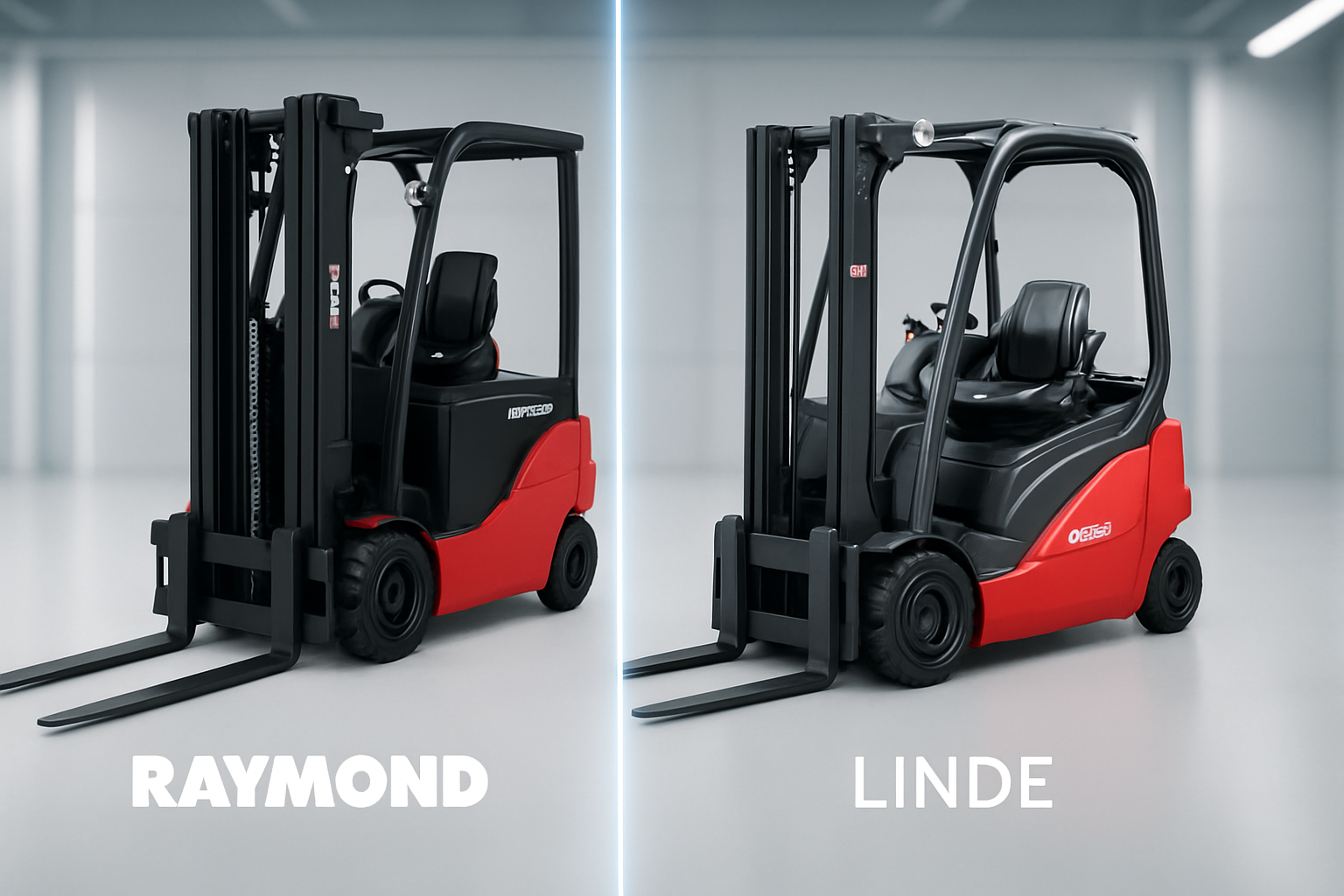
Raymond Forklifts vs Linde: Complete 2025 Comparison Guide
Key Takeaways
| Aspect | Raymond Forklifts | Linde Forklifts |
|---|---|---|
| Best For | Narrow aisle operations, customization, ergonomic comfort | High-speed operations, heavy-duty throughput |
| Technology | ACR System, advanced diagnostics, ergonomic controls | Hydrostatic drive, curve assist, load control |
| Price Range | Mid to high-tier, better value | Premium pricing |
| Maintenance | Standard mechanical, moderate costs | Lower maintenance due to fewer parts |
| Operator Comfort | Superior ergonomic design, reduced fatigue | Good comfort, advanced control systems |
| Application | Versatile warehouse, customizable solutions | High-volume, fast-paced environments |
Understanding Raymond Forklifts: A Comprehensive Overview
Raymond forklifts have carved out a dominant position in the North American material handling market since the company’s founding in 1922.
Their ‘[‘engineering teams develop solutions specifically tailored to North American warehouse operations. This focus shows in every design decision, from the ergonomic operator compartments sized for diverse body types to the intuitive control systems that reduce training time.
What sets Raymond forklifts apart:
- Specialized in electric-powered material handling equipment exclusively
- Focus on narrow aisle and high-density storage applications
- Strong emphasis on operator ergonomics and comfort features
- Comprehensive customization options for specific warehouse needs
- Extensive dealer network across United States and Canada
- Integration with iWAREHOUSE fleet optimization systems
Raymond’s core philosophy centers on maximizing warehouse space utilization while keeping operators comfortable during long shifts. This dual focus addresses two critical pain points: real estate costs that continue climbing in urban areas and the ongoing challenge of warehouse worker retention in tight labor markets.
Primary industries served:
- Retail and e-commerce fulfillment centers
- Food and beverage distribution
- Cold storage facilities
- Manufacturing and assembly operations
- Paper and printing industries
- Third-party logistics providers
The product lineup spans from entry-level pallet trucks to sophisticated turret trucks capable of operating in aisles as narrow as 5.5 feet. Each category addresses specific operational challenges, whether that’s dock-to-stock movement, high-bay storage retrieval, or order picking at various heights.
One thing I learned working with warehouse managers: the initial sticker price rarely tells the whole story. Total cost of ownership depends on energy consumption, maintenance intervals, operator productivity, and how well the equipment fits your specific workflow. Raymond’s approach leans heavily toward that last factor—customization and application-specific engineering.
Key Raymond Technologies
ACR System (Acceleration Control and Regulation):
- Automatically adjusts acceleration based on load weight
- Reduces operator fatigue from constant speed adjustments
- Improves battery runtime by 10-15% compared to standard controls
- Smoother starts prevent load shifting
- Less wear on mechanical components
AC Drive Systems:
- Regenerative braking captures energy during deceleration
- Fewer parts than DC motor systems
- Reduced maintenance requirements
- Better thermal management for consistent performance
- Longer motor life expectancy
Integrated Diagnostics:
- Real-time fault detection and error code display
- Simplifies troubleshooting for maintenance teams
- Reduces diagnostic time by 30-40%
- Downloadable performance data for fleet management
- Predictive maintenance alerts
Ergonomic Design Features:
- Low step height (8-9.25 inches) for easy entry/exit
- Suspended operator platforms reduce vibration fatigue
- Adjustable armrests and controls for different operator sizes
- Wide stance provides stability and confidence
- Clear visibility through optimized mast design
Top 3 Raymond Forklift Models
1. Raymond 7500 Universal Stance Reach Truck
The 7500 represents Raymond’s most versatile reach truck solution, offering operators the flexibility to work in stand-up, seated, or perched positions depending on the task at hand.
Specifications:
- Capacity: 3,500 to 4,500 lbs
- Maximum elevated height: 444 inches (37 feet)
- Battery: 36 volts
- Travel speed loaded: 7.0 mph
- Travel speed unloaded: 8.0 mph
Performance characteristics:
- Lift speed (loaded): 90 fpm
- Lift speed (unloaded): 168 fpm
- Lower speed: 230 fpm regardless of load
- Step height: 9.25 inches
- Turning radius: 78 inches
Ideal applications:
- Multi-shift operations where different operators prefer different stances
- Facilities with both narrow aisle racking and open floor areas
- Order picking combined with pallet movement
- Operations requiring frequent transitions between tasks
- Warehouses prioritizing operator comfort and retention
The universal stance design addresses a common problem: different operators have different preferences. Rather than forcing everyone into one working position, this model adapts to the operator. The result? Less griping, better productivity, and reduced turnover.
Customization options:
- Various mast configurations from 150″ to 444″ lift heights
- Fork lengths from 42″ to 68″
- Cold storage packages with heated components
- Enhanced visibility options including cameras
- Integration with warehouse management systems
2. Raymond 7530 High Capacity Reach Truck
When standard reach trucks lack the muscle for your loads, the 7530 steps in with impressive capacity while maintaining narrow aisle capability.
Specifications:
- Capacity: 4,500 lbs standard
- Deep-reach capacity: 2,000 lbs at 505 inches
- Maximum elevated height: 542 inches (45+ feet)
- Battery: 36 volts
- Travel speed: 7.0 mph loaded
What makes it special:
- Handles heavier loads than typical reach trucks
- Deep-reach capability extends 30+ inches beyond standard
- Dual-pallet handling in single-deep racking
- Robust construction for demanding applications
- Advanced stability systems for high lifting
Best suited for:
- Beverage distribution requiring full pallet handling
- Building materials with above-average weight
- Manufacturing facilities moving heavy components
- Food service distribution handling bulk items
- Any operation with loads consistently over 3,500 lbs
The weight-sensing technology automatically adjusts lifting and travel speeds based on actual load—not just operator input. This prevents unsafe operation while maintaining productivity when loads are lighter.
Maintenance considerations:
- Heavier-duty components increase part costs
- Slightly higher energy consumption than standard models
- Requires proper operator training on capacity limits
- Load backrest and fork inspections more critical
- Battery must meet minimum weight requirements for stability
3. Raymond 4250 Stand-Up Counterbalanced Forklift
Breaking out of the reach truck category, the 4250 offers counterbalanced design in a compact, stand-up format perfect for dock work and outdoor-indoor transitions.
Specifications:
- Capacity: 3,000 to 5,000 lbs depending on configuration
- Maximum lift height: varies by mast (up to 270+ inches)
- Battery: 36 volts
- Travel speed: 8 mph unloaded
- Gradeability: 15%
Key features:
- ComfortStance Suspension platform reduces operator fatigue
- Cushion tires for smooth indoor operation
- Compact footprint despite counterbalanced design
- Excellent visibility for loading trailers
- Capable of traversing dock plates and ramps
Typical uses:
- Loading and unloading delivery trucks
- Moving pallets from dock to staging areas
- Cross-docking operations requiring speed
- Facilities with both indoor and outdoor material flow
- Operations needing forklift versatility without sit-down bulk
The 4250 fills a specific niche that neither sit-down forklifts nor reach trucks handle well: the transition zone between warehouse and loading dock. Stand-up operation means faster mounting/dismounting, while counterbalanced design handles outdoor surfaces and trailer decks.
Available configurations:
- Models 4250-C30, C35, C40, C50 (various capacities)
- Mast options: standard tilt, special tilt, bottlers tilt
- Fork lengths up to 72 inches
- Various tire types including non-marking rubber
- Optional sideshift and fork positioner
Comparing Raymond Forklifts Technology and Design Philosophy
Raymond’s engineering approach prioritizes three core principles: space optimization, operator wellness, and application-specific customization. This philosophy manifests differently than competitors who focus primarily on raw performance metrics.
Space optimization strategies:
- Narrow chassis designs minimize aisle width requirements
- Compact turning radii reduce maneuvering space needs
- Vertical reach capabilities maximize cubic storage utilization
- Articulating and turret models for very narrow aisle (VNA) applications
- Careful attention to overall truck dimensions
In practical terms, space optimization translates directly to warehouse capacity. A facility using 10-foot aisles might store 100,000 pallets. Convert to 7-foot aisles with appropriate equipment, and that same building might hold 130,000+ pallets. The math becomes compelling quickly.
Operator wellness features:
- Ergonomic controls positioned to reduce reaching and twisting
- Low vibration levels through platform suspension systems
- Clear sight lines through transparent mast sections
- Intuitive displays with large, readable fonts
- Adjustability for operators of different heights and sizes
These features address the reality of warehouse work: operators spend 6-8+ hours daily on these machines. Reducing fatigue improves safety, productivity, and job satisfaction. Lower turnover means reduced recruiting and training costs.
Customization capabilities:
- Extensive mast options (single, double, triple stages)
- Fork length and style variations
- Cold storage packages with environmental protection
- Specialized attachments (clamps, rotators, etc.)
- Integration with warehouse management and fleet systems
| Feature Category | Raymond Approach | Industry Standard |
|---|---|---|
| Aisle Width | 7-8 feet for reach trucks | 8-10 feet typical |
| Operator Position | Multiple stance options | Fixed position |
| Diagnostics | Integrated display system | External diagnostic tools |
| Energy Management | Regenerative + ACR System | Standard regenerative only |
| Customization | Extensive factory options | Limited configurations |
Linde Forklifts Overview and Technology
Linde Material Handling, part of the KION Group, brings German engineering precision to the forklift market. Founded in 1904, Linde has built a reputation for robust construction, advanced technology, and performance in high-throughput applications.
Linde’s core strengths:
- Hydrostatic drive system for smooth, precise control
- Advanced safety features including curve assist technology
- High-speed capability for fast-paced operations
- Reduced maintenance through simplified mechanical design
- Strong performance in demanding industrial environments
The hydrostatic drive represents Linde’s signature technology. By eliminating traditional mechanical components like clutches and conventional brakes, the system reduces wear parts and maintenance intervals while providing smoother operation.
Linde’s target applications:
- High-volume distribution centers prioritizing throughput
- Manufacturing facilities with heavy-duty requirements
- Operations where speed and efficiency outweigh customization
- Environments with professional, experienced operators
- Facilities with established maintenance programs
Where Raymond focuses on versatility and ergonomics, Linde emphasizes raw performance and durability. Neither approach is inherently superior—they address different operational priorities.
Top 3 Linde Forklift Models
1. Linde R14-R20 Reach Truck Series
Linde’s reach truck lineup delivers impressive speed and lifting performance for high-density storage applications.
Key specifications:
- Capacity range: 3,100 to 4,400 lbs
- Maximum lift height: up to 39+ feet depending on mast
- Hydrostatic drive for infinite speed control
- Travel speeds exceeding typical reach truck performance
- Advanced stability systems
Performance advantages:
- Faster acceleration and deceleration than mechanical drives
- Smoother operation reduces load damage
- High lift speeds increase warehouse throughput
- Precise positioning for tight racking tolerances
- Robust construction for multi-shift operations
Technology highlights:
- Curve assist automatically reduces speed in turns
- Load control system enhances stability with heavy loads
- Regenerative braking system captures energy
- Integrated diagnostics for maintenance planning
- Optional fleet management connectivity
2. Linde P-Series Order Pickers
For operations requiring efficient order picking at height, Linde’s P-series provides stable platforms and excellent visibility.
Specifications:
- Working heights up to 39+ feet
- Platform capacities supporting operator plus picked items
- Hydrostatic drive for smooth vertical movement
- Advanced safety features including tilt monitoring
- Quick raise/lower speeds
Operational benefits:
- High pick rates through optimized controls
- Operator comfort reduces fatigue errors
- Stable platform minimizes safety incidents
- Clear visibility to racking positions
- Easy access from either side
3. Linde Electric Counterbalanced Trucks
Linde’s counterbalanced electric forklifts offer powerful performance in compact packages.
Range:
- Capacities from 3,000 to 8,000+ lbs
- Various mast configurations
- Indoor/outdoor capable models
- Three and four-wheel designs
- Multiple battery options
Advantages:
- Strong lifting performance throughout height range
- Excellent traction and gradeability
- Durable construction for industrial environments
- Efficient power management systems
- Comprehensive safety features
Raymond Forklifts vs Linde: Direct Comparison
| Comparison Factor | Raymond Forklifts | Linde Forklifts |
|---|---|---|
| Technology Focus | ACR System, ergonomics, diagnostics | Hydrostatic drive, curve assist, load control |
| Speed Capability | Optimized for balance of speed and control | Higher top speeds for throughput |
| Operator Comfort | Superior ergonomic design, multiple stance options | Good comfort, advanced control systems |
| Maintenance | Standard mechanical, moderate complexity | Lower maintenance, fewer wear parts |
| Customization | Extensive factory customization available | Standardized configurations |
| Purchase Price | Mid to high-tier pricing | Premium pricing structure |
| Energy Efficiency | Regenerative braking + ACR optimization | Regenerative braking, hydrostatic efficiency |
| Aisle Width Capability | Optimized for narrow aisles (7-8 feet) | Good narrow aisle performance |
| Training Requirements | Intuitive controls, faster operator onboarding | Requires proper training for optimal performance |
| Dealer Network (North America) | Extensive coverage, local support | Good coverage, specialized dealers |
Performance analysis:
When comparing pure performance metrics, Linde often shows higher top speeds and faster cycle times in controlled testing. The hydrostatic drive provides infinitely variable speed control and smooth operation that operators appreciate once trained.
Raymond counters with technology focused on real-world warehouse conditions: the ACR System automatically adjusts performance based on load weight, reducing operator workload. This automated optimization often results in better average performance over full shifts, even if peak capabilities are lower.
Cost considerations:
Raymond typically offers better value in the initial purchase, with competitive pricing and frequent promotional programs. Linde’s premium pricing reflects the hydrostatic drive technology and robust construction.
Maintenance costs favor Linde due to fewer mechanical wear parts in the hydrostatic system. Fewer clutch replacements, brake adjustments, and related service items reduce long-term operating costs.
Energy consumption varies by application. Linde’s hydrostatic system provides excellent efficiency in high-speed operations. Raymond’s ACR System and regenerative braking optimize energy in mixed-task environments with varying loads.
Application suitability:
Raymond excels when:
- Narrow aisle optimization is priority
- Operator comfort affects retention
- Customization addresses unique workflow needs
- Budget constraints affect purchase decisions
- Versatility across multiple tasks matters
Linde excels when:
- Maximum throughput drives profitability
- Heavy-duty applications demand durability
- Professional operators maximize equipment capability
- Lower maintenance costs justify premium pricing
- High-speed operations are primary focus
Which Should You Choose: Raymond or Linde?
The “better” choice depends entirely on your operational requirements, budget, and priorities. Neither brand universally outperforms the other—they excel in different scenarios.
Choose Raymond forklifts when:
- Budget constraints limit capital equipment spending
- Operator turnover makes ergonomics critical
- Narrow aisles maximize your warehouse capacity
- Application-specific customization solves unique challenges
- Local dealer support and parts availability matter
- Training time needs minimization through intuitive controls
- Fleet includes operators of varying experience levels
Choose Linde when:
- Throughput capacity directly impacts revenue
- Heavy-duty applications justify premium investment
- Experienced operators can maximize performance capabilities
- Lower long-term maintenance costs outweigh higher purchase price
- High-speed operations define your workflow
- Established maintenance programs handle specialized equipment
- Brand reputation influences customer/stakeholder perceptions
Consider these additional factors:
Dealer quality matters enormously. An excellent local Raymond dealer providing responsive service often delivers better results than a distant Linde dealer with limited support. Evaluate dealer capabilities as carefully as equipment specifications.
Fleet integration affects efficiency. Mixing brands complicates training, maintenance, and parts inventory. Consider how new purchases fit existing fleet composition.
Financing options vary. Raymond dealers often provide attractive financing through partnerships. Linde’s premium positioning may offer different financial structures.
Resale value follows brand perception. Both brands maintain reasonable resale values, though Linde’s premium positioning sometimes translates to stronger used equipment prices in certain markets.
Maintenance and Operating Costs Comparison
| Cost Category | Raymond Forklifts | Linde Forklifts |
|---|---|---|
| Purchase Price | $$ (mid-tier) | $$$ (premium) |
| Annual Maintenance | $$ (moderate) | $ (lower due to fewer parts) |
| Energy Consumption | $ (efficient with ACR) | $ (efficient hydrostatic) |
| Parts Availability | Excellent (extensive network) | Good (specialized dealers) |
| Operator Training | $ (intuitive, faster) | $$ (requires proper training) |
| Downtime Risk | Low (common parts, quick service) | Low (robust construction) |
| 5-Year TCO | $$ (good value) | $$-$$$ (higher initial, lower maintenance) |
Preventive maintenance schedules:
Raymond equipment typically requires:
- 250-hour inspections: fluid checks, basic adjustments
- 1,000-hour services: comprehensive inspection, wear part replacement
- 2,000-hour major services: detailed inspection, component overhaul as needed
Linde equipment generally follows:
- 500-hour inspections: hydrostatic system checks, general inspection
- 1,500-hour services: comprehensive service, wear item replacement
- 3,000-hour major services: system overhaul, detailed inspection
The hydrostatic system reduces frequency of certain maintenance tasks but requires specialized knowledge. Not all service providers have Linde-trained technicians.
Common maintenance items:
Raymond typical wear parts:
- Hydraulic hoses and fittings
- Brake components (though less with regenerative systems)
- Wheels and casters
- Electrical contactors
- Mast chains and bearings
Linde typical wear parts:
- Hydraulic system components
- Hydrostatic drive maintenance (less frequent)
- Wheels and load wheels
- Mast components
- Electrical systems
Operator Training Considerations
Raymond training characteristics:
- Intuitive controls reduce initial learning curve
- ACR System automates many performance adjustments
- Multifunction displays provide clear feedback
- Lower barrier to entry for new operators
- Faster transition between different Raymond models
Most operators become productive on Raymond equipment within 1-2 shifts of supervised operation. The ergonomic design and straightforward controls minimize the “getting used to it” period.
Linde training requirements:
- Hydrostatic controls require understanding of system logic
- Optimal performance needs proper technique
- Advanced features benefit from comprehensive training
- Experienced operators appreciate performance capabilities
- Steeper initial learning curve
Properly trained operators extract better performance from Linde equipment than Raymond. Without proper training, the performance advantage diminishes.
Training program recommendations:
Regardless of brand:
- Formal classroom instruction covering safety and theory
- Supervised hands-on operation (minimum 4-8 hours)
- Evaluation and certification before independent operation
- Annual refresher training
- Specific training when changing equipment types
Investment in quality training programs pays dividends through reduced accidents, lower equipment damage, and improved productivity. Budget both time and money for comprehensive operator development.
Common FAQs
Are Raymond forklifts made in the USA?
Yes, Raymond manufactures its forklifts in Greene, New York, where the company has operated since 1922. This domestic production supports local jobs and enables close collaboration between engineering, manufacturing, and customer feedback teams. The Made in USA status also simplifies parts sourcing and warranty support for North American customers.
What is the load capacity range for Raymond reach trucks?
Raymond reach trucks typically range from 2,500 lbs to 4,500 lbs capacity, with specialized high-capacity models like the 7530 handling loads up to 4,500 lbs at standard load center. Deep-reach configurations reduce capacity at extended reach depths—for example, the 7530 handles 2,000 lbs at 505 inches of reach. Always verify specific model specifications for your application requirements.
How does the hydrostatic drive system in Linde forklifts work?
Linde’s hydrostatic drive uses hydraulic fluid under pressure to transmit power from the motor to the wheels and hydraulic functions. Unlike mechanical transmissions with clutches and gears, hydrostatic systems provide infinitely variable speed control through fluid flow adjustments. This eliminates many wear components while providing smooth, precise control. The main downside: repairs require specialized knowledge and may cost more than conventional mechanical systems.
What is Raymond’s ACR System and what benefits does it provide?
The ACR (Acceleration Control and Regulation) System automatically adjusts truck acceleration based on load weight, floor conditions, and operator input. Benefits include reduced operator fatigue (no constant manual adjustments), improved battery runtime (10-15% improvement typical), smoother operation that prevents load shifting, and extended component life through reduced mechanical stress. Think of it as cruise control but much more sophisticated, constantly optimizing performance parameters.
Can Raymond forklifts operate in cold storage environments?
Yes, Raymond offers cold storage packages for many models that include heated operator compartments, environmental sealing for electrical components, special lubricants rated for low temperatures, and heated hydraulic fluid reservoirs. These packages enable operation in temperatures down to -20°F or lower. Standard equipment without cold storage protection will experience reduced battery performance, hydraulic issues, and potential operator safety problems in freezing environments.
What aisle width do I need for Raymond reach trucks?
Most Raymond reach trucks operate efficiently in aisles 7 to 8 feet wide, though specific requirements depend on load dimensions and turning radius. The 7500 series typically needs 8-foot aisles for comfortable operation with standard 48-inch pallets. Very narrow aisle (VNA) equipment like turret trucks can work in aisles as narrow as 5.5 to 6 feet but require wire guidance or rail systems. Always calculate aisle requirements based on: truck turning radius + load length + clearance (12-18 inches total).
How long does a forklift battery typically last?
Quality forklift batteries properly maintained typically last 1,500 to 2,000 charge cycles, translating to 5-7 years in single-shift operations. Multi-shift operations using opportunity charging may see 3-5 years. Key factors affecting battery life include charging practices (avoid partial charges and overcharging), proper watering maintenance, temperature management, and avoiding deep discharges below 20% capacity. Budget $4,000-$8,000 for replacement batteries depending on voltage and capacity requirements.
What is the average maintenance cost for Raymond vs Linde forklifts?
Annual maintenance costs typically run $2,000-$4,000 for Raymond equipment in single-shift operation, covering preventive maintenance, wear parts, and minor repairs. Linde equipment often runs $1,500-$3,500 annually due to fewer mechanical wear components in the hydrostatic system. These figures exclude major repairs, accident damage, and operator abuse. Multi-shift operations typically see 60-80% higher maintenance costs due to increased usage hours.
Can I get financing for forklift purchases?
Yes, multiple financing options exist including direct manufacturer financing programs, equipment leasing companies, and bank loans. Raymond dealers typically offer competitive financing through partner banks with terms from 36-72 months. Leasing options provide lower monthly payments but no ownership equity. Many operations find that financing or leasing conserves capital for other business needs while spreading equipment costs over the useful life. Interest rates vary based on creditworthiness but typically range 4-8% currently.
What warranty coverage comes with new Raymond forklifts?
Raymond typically provides 12-month comprehensive warranty coverage on new equipment, covering parts and labor for manufacturing defects and component failures. Extended warranty options are available for purchase, extending coverage to 36-60 months. Critical components like drive motors and hydraulic systems may carry longer standard warranties. Battery warranties are separate, usually 12-36 months depending on manufacturer. Always review specific warranty terms before purchase as coverage varies by model and dealer.
How does operator comfort compare between Raymond and Linde?
Raymond generally leads in operator ergonomics with features like low step height (8-9.25 inches), suspended platforms, multiple stance options, and highly adjustable controls. Operator feedback consistently rates Raymond higher for all-day comfort and reduced fatigue. Linde provides good comfort with quality seating and smooth hydrostatic control but doesn’t emphasize ergonomics to the same degree. For operations with high operator turnover or long shifts, Raymond’s comfort advantage often translates to measurable productivity and retention benefits.
What is the typical lifespan of a forklift?
Well-maintained forklifts typically last 10,000-20,000 operating hours before major refurbishment or replacement. In single-shift operation (2,000 hours annually), that’s 5-10 years. Multi-shift operations reach these hours faster, sometimes in 3-5 years. However, equipment can last much longer with proper maintenance, component replacement, and refurbishment. Many operations run 15-20+ year old equipment successfully. The decision to replace often comes down to maintenance costs exceeding replacement value, not equipment failure.
Do Raymond forklifts have better resale value than other brands?
Raymond equipment maintains solid resale value in the North American market, typically retaining 40-60% of original value after 3-5 years depending on hours, condition, and model. Linde equipment sometimes commands slightly higher resale percentages (45-65%) due to premium brand positioning and lower usage hour expectations. Popular models in good condition with comprehensive service records sell fastest. Specialized configurations or outdated technology reduce resale values significantly.
What safety features are standard on modern Raymond forklifts?
Standard safety features typically include operator presence systems (truck won’t operate unless operator is properly positioned), automatic parking brakes, hour meters and fault code displays, backup alarms, LED warning lights, overhead guards meeting OSHA standards, load backrests, and operator restraint systems. Advanced models add features like curve speed reduction, tilt interlocks, pedestrian detection systems, and automated stability control. Always verify specific model features as safety equipment varies.
How much training is required to operate Raymond forklifts safely?
OSHA requires formal training including classroom instruction, practical hands-on training, and evaluation before operators can work independently. Typical programs run 4-12 hours depending on operator experience and equipment complexity. Raymond’s intuitive controls generally reduce training time compared to more complex systems. Annual refresher training is mandatory, and retraining is required when operators change equipment types or after incidents. Budget adequate time—rushed training increases accident risk substantially.
Making Your Final Decision
After reviewing specifications, comparing technologies, and analyzing costs, the decision ultimately comes down to matching equipment capabilities to your specific operational requirements.
Critical decision factors:
- Warehouse layout and aisle width requirements determine equipment dimensions
- Throughput expectations affect speed and performance needs
- Operator experience levels influence training requirements and control complexity
- Budget constraints balance initial costs against long-term value
- Dealer quality and location affect service response and support
- Application specifics may require customization capabilities
Many successful operations run mixed fleets, using Raymond equipment for versatility and ergonomics in general applications while deploying Linde equipment for specialized high-performance applications. This hybrid approach optimizes equipment to task rather than forcing one-size-fits-all solutions.
Implementation recommendations:
Before purchasing, conduct equipment demonstrations in your actual facility. Load typical pallets, navigate your aisles, and let operators provide feedback. Paper specifications don’t capture the feel and fit of equipment in real-world conditions.
Request detailed total cost of ownership analysis from competing dealers. Include purchase price, financing costs, maintenance estimates, energy consumption, training requirements, and expected productivity. The lowest purchase price rarely represents the best value.
Check dealer references from current customers in similar applications. Service quality varies dramatically between dealers even within the same brand. Responsive support makes or breaks equipment satisfaction.
Consider long-term fleet strategy. Will you standardize on one brand or maintain mixed fleet? Each approach has advantages—standardization simplifies training and parts inventory, while mixed fleets optimize equipment to specific tasks.
Conclusion
Both Raymond forklifts and Linde bring substantial capabilities to warehouse operations, just with different emphasis. Raymond’s focus on ergonomics, customization, and value positions the brand well for operations prioritizing operator comfort, versatility, and budget optimization. Linde’s performance-oriented engineering, hydrostatic technology, and robust construction serve high-throughput operations where premium investment pays dividends through productivity and durability.
Rather than declaring one brand universally superior, smart warehouse managers match equipment to application. Evaluate your priorities—speed or versatility, initial cost or long-term maintenance, standardization or optimization—and choose accordingly.
Test equipment in your facility. Talk to current users. Calculate total cost of ownership. Most importantly, involve operators in the decision. Their feedback and comfort directly impact productivity and safety.
The right forklift isn’t the one with the best specifications on paper. It’s the one that fits your operation, budget, and people. Both Raymond and Linde manufacture excellent equipment capable of years of productive service. Your job is determining which excellence matches your needs.
What’s been your experience with material handling equipment? Drop a comment sharing what worked—or didn’t—in your operation. Real-world insights help everyone make better decisions.
Works Cited
“7530 High Capacity Reach Truck.” Raymond Corporation, www.raymondcorp.com/equipment/reach-trucks/7530-high-capacity. Accessed 14 Nov. 2025.
“Best The Raymond Corporation Reach Trucks 2025.” Allmachines, www.allmachines.com/manufacturers/the-raymond-corporation/reach-trucks. Accessed 14 Nov. 2025.
“Comprehensive Guide to Linde Forklifts vs Raymond Forklifts.” Total Warehouse, www.totalwarehouse.com/blogs/linde-forklifts-vs-raymond-forklifts/. Accessed 14 Nov. 2025.
“Reach Fork Trucks | Raymond Narrow Aisle Forklifts.” Raymond Handling Concepts, www.raymondhc.com/forklifts/reach-trucks. Accessed 14 Nov. 2025.
“Raymond 7700 Reach Truck: Specs Manuals.” Allmachines, www.allmachines.com/equipment/the-raymond-corporation-7700. 14 Aug. 2022.
“Raymond Stand-Up Counterbalanced Forklift Trucks Models 4150/4250.” Raymond Corporation, www.raymond.mx. Accessed 14 Nov. 2025.