Pallet Racking Styles: How to Identify the 6 Most Common Types
Know what you have before you buy another beam
Pallet racking comes in a variety of styles, and knowing which one is already standing in your building matters more than most operators expect. Order the wrong beams and they will not seat. Mix incompatible uprights and you have a safety problem instead of a storage solution.
At Total Warehouse, we help businesses identify the right pallet racking setup and support it end to end, from engineering and installation through the lighting, safety features, and supporting equipment that take a warehouse from early construction to full operation.
This guide walks through the six most common pallet racking styles found across the United States, how to tell them apart on the floor, and which ones will and will not work together.
Start at the connection point
To identify the racking style you have, look at where the beams meet the uprights. That connection is the fingerprint.
Most systems use one of three approaches:
- Hook and slot — beam connectors hook into punched slots on the upright
- Pin and slot — pins on the beam connector seat into slots at fixed spacing
- Bracket and fastener — beams bolt to the upright
From there, three details narrow it down quickly:
- Slot shape. Teardrop-shaped keyholes, rectangular slots, and mushroom-shaped openings each point to a different family.
- Slot or pin spacing. Measure center to center. 2-inch spacing, 4-inch spacing, and everything between are meaningful clues.
- Color. Manufacturers tend to stay consistent, and some color combinations are effectively exclusive to a single brand.
Quick identification reference
|
Style |
Connection |
Identifying detail |
Typical colors |
|
Teardrop |
Pin and slot |
Tapered keyholes on 2-inch centers |
Varies widely |
|
Structural (hybrid) |
Bolted uprights, teardrop beams |
Heavy structural steel posts |
Varies widely |
|
New-Style (Interlake) |
Pin and slot |
Rectangular slots, pins 2 to 4 inches apart |
Orange beams, green uprights |
|
Sammons |
Pin and slot |
Mushroom-shaped pins, slots 4 inches apart |
Grey beams and uprights |
|
Ridg-U-Rak |
Hook and slot |
Rectangular slots, spring plus two locking pins |
Varies |
|
T-Bolt |
Bolted |
Rectangular slots on both columns and beams |
Blue uprights, yellow beams |
Teardrop Rack
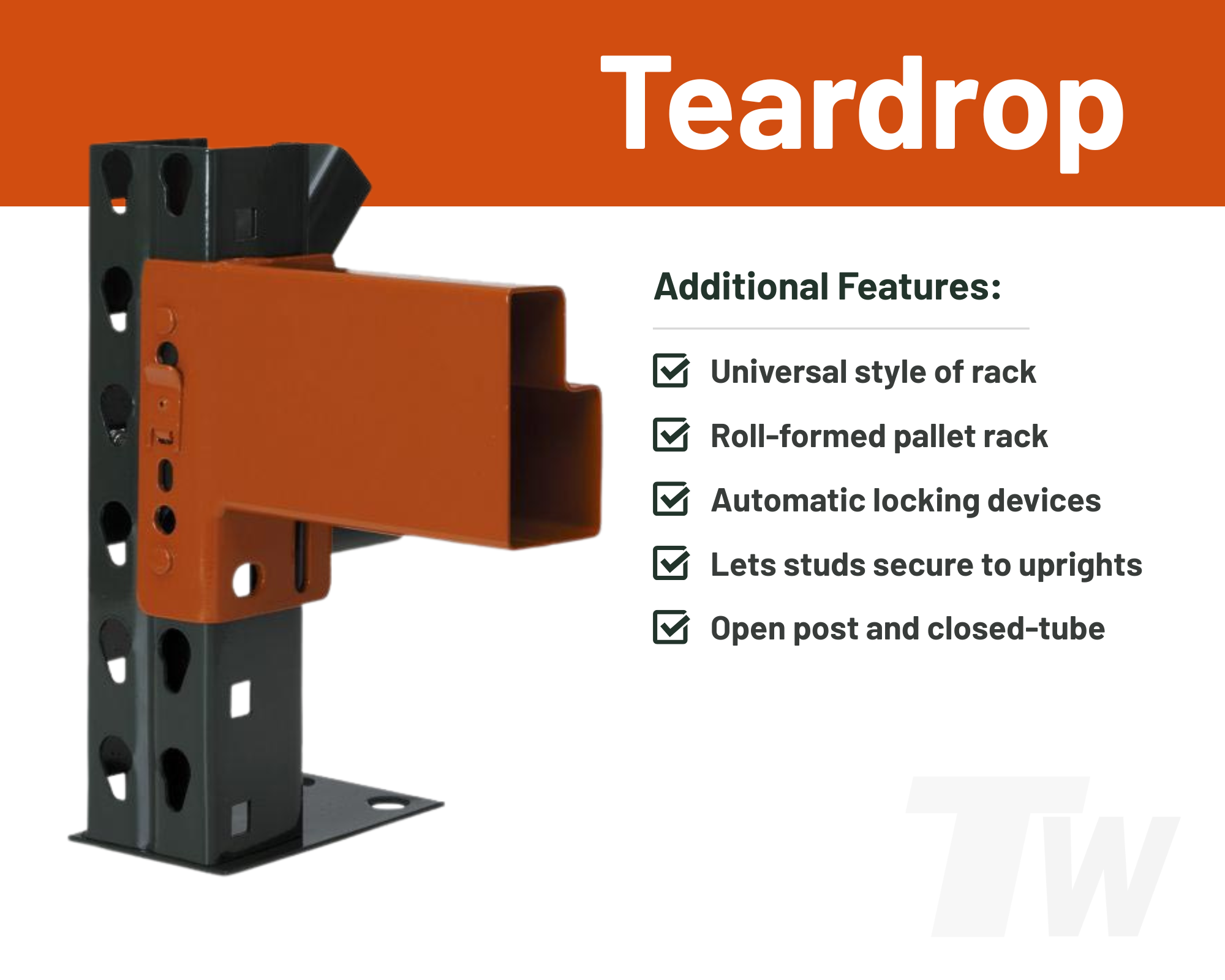
Teardrop is the most widely compatible design on the market, which is why it shows up in more warehouses than any other style.
Uprights are punched with tapered keyholes on 2-inch centers. Beams install with riveted studs that drop into those keyholes and lock without tools, which makes reconfiguring beam levels a fast job rather than a project.
Because it is roll-formed and available in multiple beam heights and gauges, teardrop gives you flexibility without giving up strength. The practical advantage is sourcing: when a beam gets damaged or you need to expand, the standardized design means replacement components are widely available, including on the used market.
Best for: general selective storage, operations that reconfigure often, and anyone who wants the easiest path to future expansion.
Structural Rack
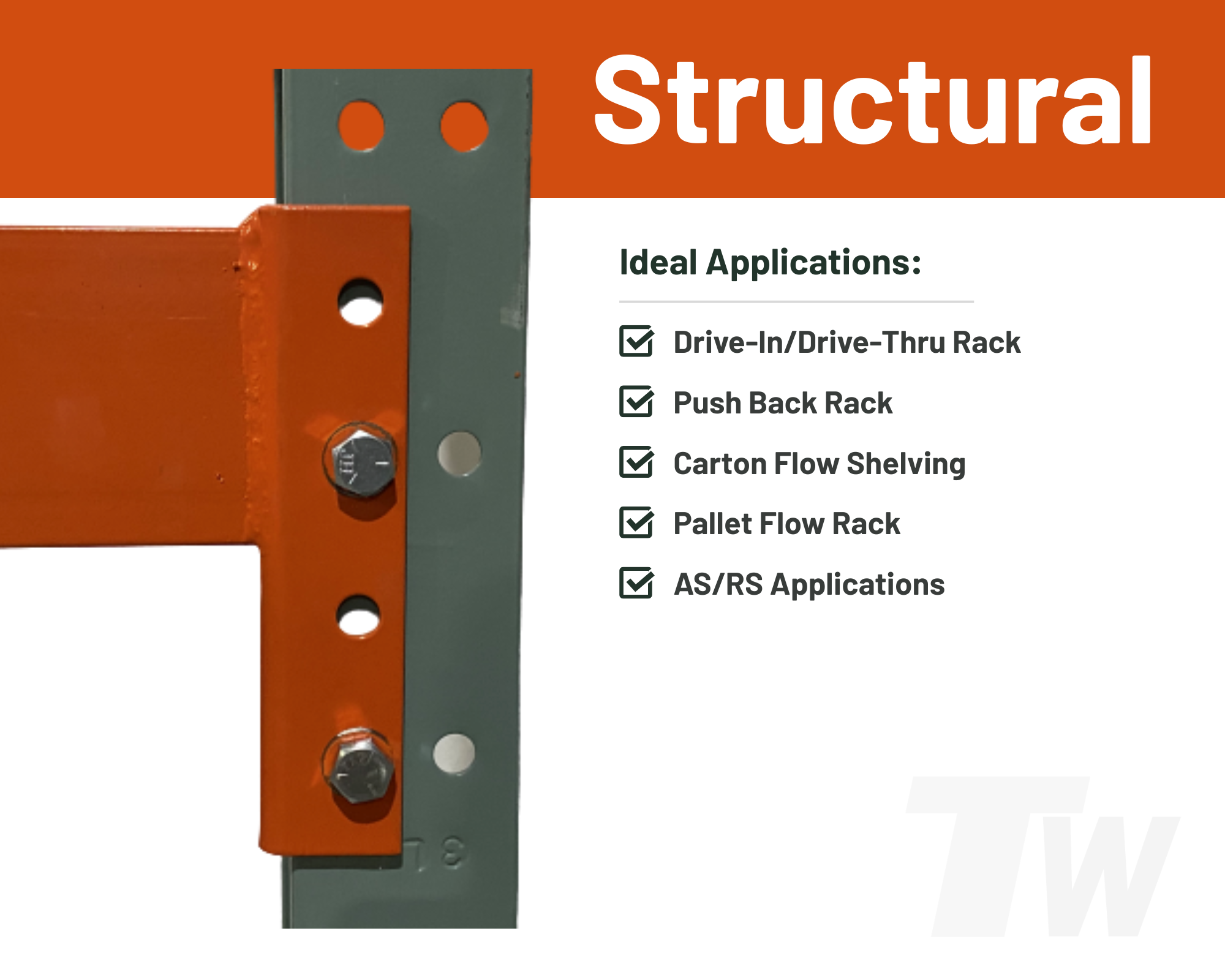
Hybrid structural racking pairs structural steel uprights with roll-formed teardrop beams. You get the impact resistance of structural steel where damage happens and the cost efficiency and adjustability of roll-formed beams everywhere else.
Thicker steel posts at the key impact points are the difference-maker in high-traffic environments. If your uprights are taking regular hits from forklift traffic, the repair and replacement cycle on roll-formed columns adds up fast, and structural changes that math.
Total Warehouse engineers custom solutions using heavy-duty structural racks for advanced applications including:
- Pick modules
- AS/RS systems
- Push back rack
- Drive-in and drive-thru rack
- Carton flow and pallet flow systems
Best for: high-traffic aisles, cold storage, food and beverage, and any application where forklift damage is a recurring line item.
New-Style Rack
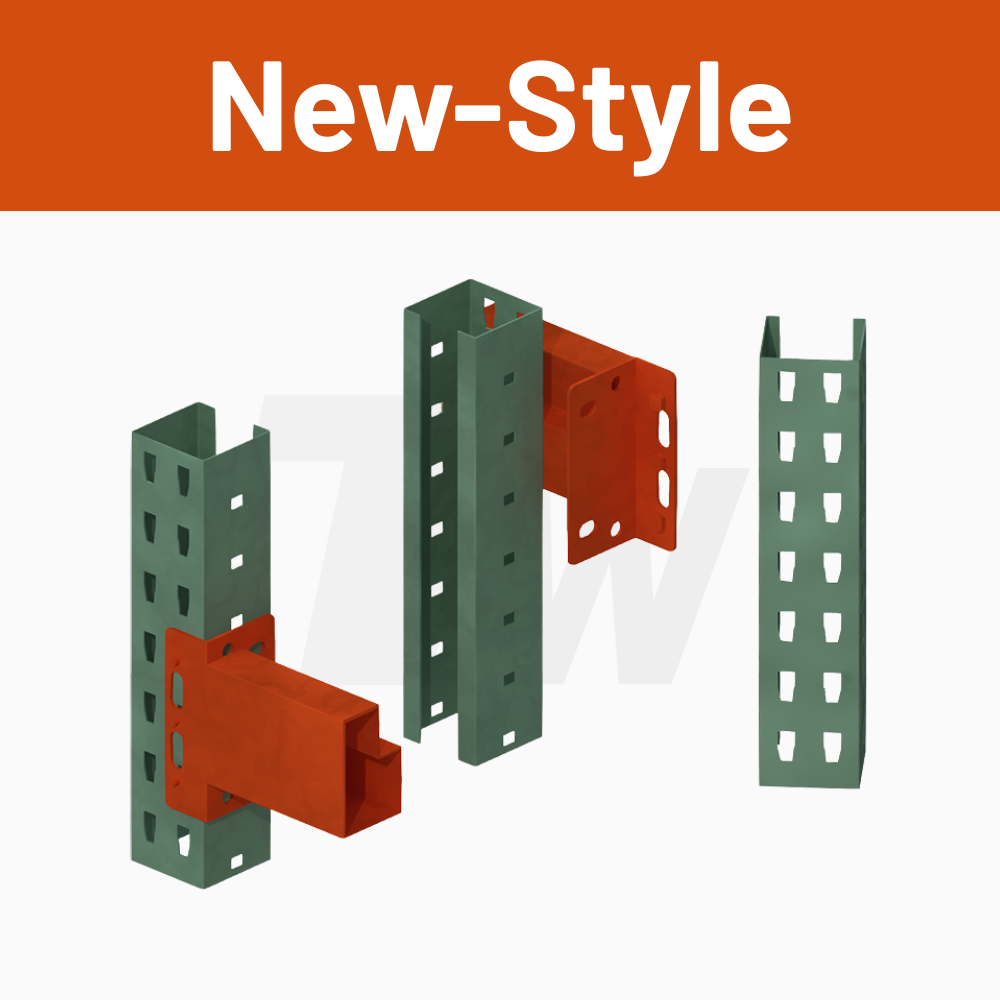
New-Style racking, sometimes called Interlake New Style, is compatible with teardrop. That compatibility is the headline: if you need to mix and match components, particularly when sourcing used material, New-Style opens up inventory that would otherwise be off the table.
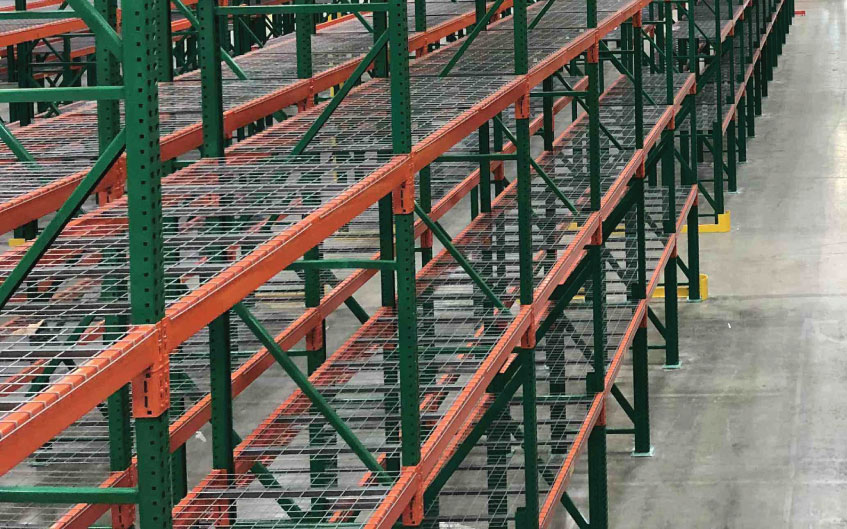
Identify it by the rectangular slots on the uprights and by pins spaced 2 to 4 inches apart on the load beams. It commonly shows up with orange load beams and green uprights.
Best for: expanding or repairing an existing system where matching components exactly is proving difficult or expensive.
Additional Rack Styles
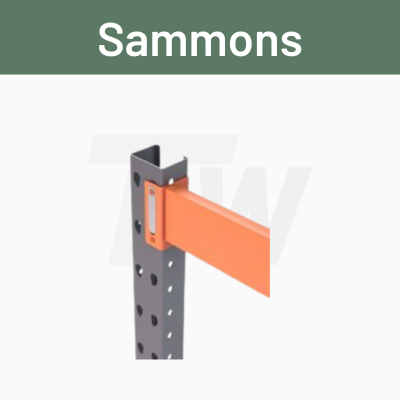
Sammons racking is most commonly seen on the West Coast. At a glance it resembles teardrop, which is exactly how sourcing mistakes happen.
The tell is the connector pins. Sammons uses mushroom-shaped pins that seat into slots spaced 4 inches apart, not the tapered keyholes of a true teardrop system. It is typically paired with grey load beams and grey uprights.
Best for: operations already standardized on Sammons. If you are identifying racking for a purchase or expansion, confirm the pin shape before ordering anything labeled teardrop.
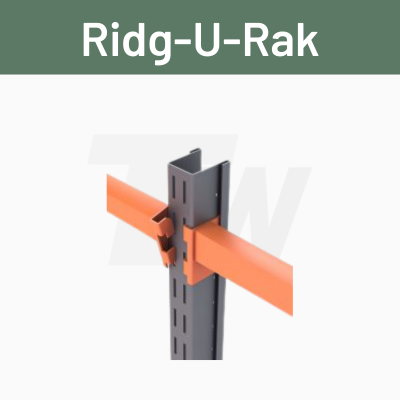
Ridg-U-Rak uses a hook and slot connection and is identifiable by the distinctive rectangular slots on its uprights.
The beams are comparatively thin and connect to the uprights with a spring component and two pins that lock securely into place. The result is a system that is both sturdy and flexible, and one that holds up well across a wide range of general warehouse applications.
Best for: general storage where a proven hook and slot connection is preferred.
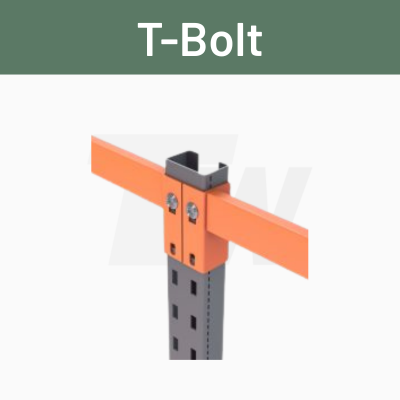
T-Bolt is the easiest style to spot. Rectangular slots appear on both the columns and the load beams, and the beams attach with bolts rather than a drop-in connector.
That bolted connection is the whole point. A fastened joint resists the cyclical loading that seismic activity produces, which makes T-Bolt a common specification in high seismic areas. Installation takes longer than a tool-free system, and that tradeoff is deliberate.
T-Bolt racks usually come with blue uprights and yellow load beams.
Best for: high seismic zones and any facility where engineered, fastened connections are required by code.
A note on mixing racking styles
Not all racking styles are compatible with each other, and this is where operations get into trouble.
Teardrop and New-Style components can generally be mixed. Most other combinations cannot. Beyond the connection geometry, there is a second issue that matters more: beam and upright capacities are engineered as a system. Even when two components physically fit together, the resulting configuration may not carry the load you expect.
Before mixing components from different systems or different manufacturers, have the configuration reviewed. A load capacity plaque that no longer reflects what is actually installed is a genuine compliance exposure.
Frequently asked questions
How do I identify what pallet racking I have?
Look at the connection between the beam and the upright. The slot shape (teardrop keyhole, rectangular, mushroom), the spacing between slots, and the color combination will identify most systems. Photographing the connection point and the upright punch pattern gives a supplier everything they need to match it.
Can I mix different brands of pallet racking?
Sometimes. Teardrop and New-Style components are generally compatible. Most other combinations are not, and even components that physically fit may not be rated as a system. Have any mixed configuration reviewed before loading it.
What is the difference between roll-formed and structural racking?
Roll-formed racking is made from bent sheet steel and is lighter, less expensive, and highly adjustable. Structural racking uses hot-rolled structural steel, weighs more, costs more, and resists forklift impact far better. Hybrid systems combine structural uprights with roll-formed beams to get both.
Which racking style is best for seismic areas?
T-Bolt is common in high seismic zones because the bolted beam-to-column connection resists cyclical loading. Seismic requirements are set by local code and the specific configuration should be engineered for the site.
Can I buy used pallet racking?
Yes, and teardrop and New-Style are the easiest styles to source used because of how widely compatible they are. Used racking should always be inspected for damage and verified against the capacities your application requires.
Need help expanding or servicing your racking system?
Whether you are expanding a current system, repairing damaged components, or trying to identify what you already have, Total Warehouse is here to support you.
Our team provides:
- Expert on-site assessments
- Engineering and permit support
- Replacement parts and components
- Full-service installation
- Safety and code compliance review
We help keep your warehouse safe, efficient, and code-compliant from planning through installation.
Call (833) 868-2500 or email online@totalwarehouse.com to talk with a racking specialist today.